Artificial Intelligence (AI) & Today’s Modern Intranet
Whitepaper


At Akumina, we're building digital workplace experiences that put users first. One of the core pillars of that experience is search. We sat down with Ed Rogers, CEO, and Jason Arden, VP of Engineering, to explore how our evolving search strategy is transforming how employees find information—faster, smarter, and with less IT effort.
Q: Ed, let's start with the big picture. Why has search become such a critical component for today's enterprises, and how does Akumina's approach address the challenges organizations are facing?
Ed: For our customers, the intranet is the central hub for communication, culture, and internal branding. But for employees, it’s more than that—it’s their go-to destination for self-service and self-help. When an employee lands on the intranet, it’s usually because they need to find something or someone—right now. Maybe it's a form, a policy, a colleague, or an answer to a question. And the number one tool for that self-service is search. Without strong, effective search, intranet adoption suffers. If people don’t use the platform, it doesn’t matter how much content or communication lives there—it’s just not reaching them.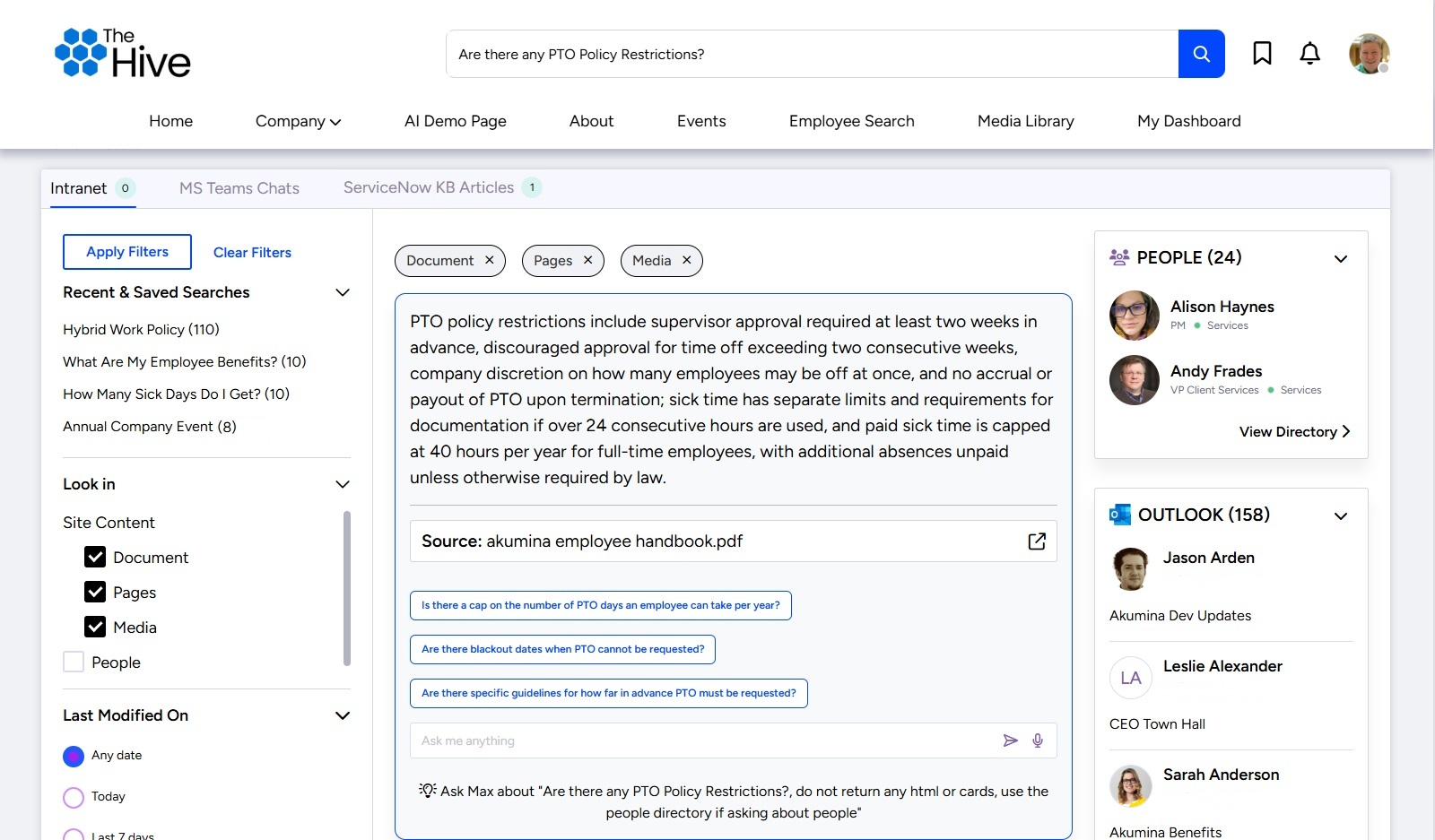
Q: Jason, from a technical perspective, what differentiates Akumina's search capabilities from other solutions in the market? What makes our architecture unique?
Jason: It starts with how we define search—not as a feature, but as a framework and strategy. Our approach is modular, intelligent, and flexible. We use a decoupled front-end architecture, giving developers and admins modular control using view templates to configure the way results are presented. Our search is also deeply contextual and personalized through role-based targeting—what we call persona-based delivery. And everything is designed to be AI-ready from the ground up utilizing some new technology called handshakes and conversation starters.
Q: Ed, one challenge we hear about constantly is employees wasting time searching across multiple systems. Can you talk about our "single pane of glass" approach and how it solves this problem?
Ed: The larger the enterprise, the more likely it is that information is spread across multiple IT systems. You’ve got systems for documents, HR, knowledge bases, communication—the list goes on. But what you don’t want is to force employees to think, “Which system holds the info I need?” That’s just not natural. People think about what they need, not where it’s stored. That’s why centralized, intelligent search is critical. We deliver not just relevant results, but are focused on delivering an experience that mirrors how the searcher thinks. It’s not just about retrieval—it’s about alignment.
Q: Let's talk more about artificial intelligence and search – how do they complement each other? How does Akumina leverage AI to improve the search experience?
Jason: AI makes search smarter and more human. Users don’t want to scroll through endless results—they expect the right answer, right away. Users rarely even go to the second page, or even to the bottom of the 1st page. That’s where our AI comes in. It enables natural language understanding, so employees can ask real questions instead of crafting keyword strings. Our AI Handshake technology matches intent with context to deliver the most relevant results within the first few items. The focus is on reducing effort and delivering confidence.
Q: Ed, personalization is a key theme in everything we do. How does Akumina's search functionality deliver truly personalized experiences?
Ed: When an employee uses search, they’re looking for the right result for them. Someone in HR in London shouldn’t see the same content as a frontline worker in Texas or an IT manager in Bangalore. Their roles, responsibilities, and locations should shape what shows up. Our search experience is driven by contextual awareness—who the employee is, what they do, how they like to work. That includes language, device, even layout preferences. This personalization helps people act faster, increasing both satisfaction and adoption.
Q: One concern many organizations have is the complexity of implementing and maintaining search. How does Akumina make it accessible?
Jason: That’s a common challenge, and we’ve designed our platform to eliminate that friction. Our low-code configuration model means there's no need to write code to configure search scopes, filters, layouts, or relevance logic. We ship with pre-built widgets and templates for common needs like employee directories, document libraries, and knowledge bases. We also abstract the complexity of connecting to API's — whether SharePoint, Microsoft Graph, or 3rd Parties. Admins can plug in and manage sources through configuration screens or admin tools, and all of it respects built-in security and persona-awareness.
Q: Ed, can you share examples of how customers are transforming discovery through Akumina’s search?
Ed: Absolutely. One global manufacturer used Akumina to deliver results across SharePoint, ServiceNow, and Confluence. A frontline worker in Poland could search for a safety checklist and get it—in Polish, filtered by their role. Another customer, a healthcare provider, used our search to reduce HR and IT tickets by surfacing answers instantly through intelligent knowledge search. That shift—from support burden to self-service—is a huge win.
Q: What kind of improvements can customers expect after implementing our search strategy?
Jason: Customers will see huge gains in how easily users find what they need. With federated results, smart filters, and boosted relevance, content becomes much more discoverable—even with vague searches. Plus, personalized and role-based targeting cuts down noise so people get to the right info faster. Over time, search becomes a go-to tool, not a backup plan—driving return visits and making the intranet a real knowledge hub. And with built-in analytics, teams can fine-tune without leaning on IT.
Q: Looking ahead, what’s the future of search at Akumina?
Ed: We’re heading toward a future where search becomes a conversation. Employees won’t type “benefits form”—they’ll ask, “How do I enroll my spouse?” AI will synthesize an answer and show the source documents behind it. Then the employee can keep asking follow-up questions. That’s search evolving into guidance.
Jason: From a tech standpoint - The future of search at Akumina is centered around AI. We're evolving from basic keyword matching to semantic search and conversational interfaces. As AI takes a larger role, it’s not just enhancing the intranet—it’s reshaping it. Search could eventually replace traditional menus and navigation, making it the primary way employees access knowledge and get things done.
At Akumina, we're committed to making that experience intelligent, intuitive, and personal.
Ed and Jason’s insights show how we're transforming enterprise search into a strategic advantage.
Whether you’re a current customer or exploring what's possible, Akumina's search strategy is built for the future of work—where every moment, every interaction, and every result drives real impact.
See for yourself - book a demo today!