

Employee Productivity Killers
In 2021, we hosted an interactive roundtable on employee engagement at the Intra.NET Reloaded event in Boston, MA. With some of the world's leading internal communications and digital workplace experts and stakeholders, we discussed the challenges organizations face in meeting employees' changing needs and expectations. Years later, those challenges still prevent good employee productivity and engagement levels within many organizations.
US labor productivity has been continually growing, hitting the highest level since 2004 in 2023, at 2.7% growth1. But this doesn't mean every business has more productive employees and doesn't mean that productivity growth won't be hard to achieve next year. So, precisely what is employee productivity, and what challenges do you need to overcome to grow?
What is Employee Productivity?
Employee productivity measures an employee's ability to efficiently and effectively complete tasks, achieve desired outcomes, and contribute positively to organizational goals while maintaining a high quality of work and a positive level of engagement. However, within a business, employee productivity also encompasses a broader set of factors, including:
- Efficiency refers to how effectively employees utilize their time and resources to accomplish tasks. It involves minimizing wasted effort and optimizing workflows.
- Effectiveness focuses on achieving desired outcomes and meeting organizational goals. It's about producing high-quality work that aligns with strategic objectives.
- Quality of Work emphasizes the work's accuracy, precision, and thoroughness. It's about delivering results that meet or exceed expectations.
- Employee Engagement refers to employees' involvement, enthusiasm, and commitment towards their work and the organization. Engaged employees are more likely to be productive and contribute positively to the workplace.
Everyone wants a more productive business. Highly productive employees make an organization more successful by increasing revenue and profitability. The contrast between disengaged and productive employees can easily show the value they bring. Gallup estimates that in 2023, only 33% of employees were engaged in their work, costing an estimated $1.9 trillion in lost productivity2.
Employee Productivity vs. Hours Worked: A Crucial Distinction
Hours worked do not equate to productivity. As we all know, getting to the office, collaborating with colleagues, networking, and actively contributing to meetings can take up much time but they don't count towards knocking through your workload. Employee productivity is the amount of quality work an employee completes in a given time, while hours worked is the amount of time an employee spends working.
Traditional business wisdom often equates being busy or in the office with being productive. Spending time on tasks that don't contribute to your goals or could be done more efficiently is also not productive, but it takes up more hours. As we move towards more of a gig economy for knowledge workers and still more employees desire remote or hybrid work set-ups, many people find that the traditional eight-hour day isn't productive. While research varies, some studies and surveys show the average employee is only productive for 2 hours and 53 minutes within the average 8-hour day3.
While 8-hour days were the dream in the 19th century, somewhere here in the 21st, labor has become less manual and more focused on knowledge, computers, and desks. 'Deep work' has become increasingly necessary, but it's hard to concentrate like this for more than three or four hours a day4. Modern workplaces expect constant availability, with consistent pressure to respond to emails, messages, and notifications from tasks or project management software. 'Always-on' culture has a negative impact as time goes on, with 78.3% of workers saying it negatively impacts their lives, causing poor sleep, elevated stress, and exhaustion5.
Factors Affecting Employee Productivity
Things that take away from productivity in the time we have available include:
- Communication Overload: Whether this is from day-to-day work or business-wide comms, more than half of employees admitted to feeling overwhelmed by receiving too much communication through too many channels at work.6
- Email: Email notifications are constant, with hundreds of messages to read and respond to daily. Plus, almost every system brought into an organization to increase productivity defaults to creating 'useful' alerts via email, which employees then ignore. What's the point of communications if they are usually ignored or filtered to a folder?
- Instant messages: Even organizations that have gotten out of email still face communication overload. Between direct messages, chats, phone calls, commenting, and more, employees are inundated with instant real-time communication from multiple sources, creating too many channels to keep up with and no clarity on what platform to use when.
- Meetings: The pandemic radically increased the frequency of meetings for most people7, with research showing that remote meetings remain exceptionally high post-pandemic. 83.13% of Dialpad's 2022 survey respondents spent up to a third of their workweek in meetings (8). We all know how often a meeting could have been an email and how frustrating it can be to sit through a meeting we didn't need to attend. We all have a feeling; 67% of workers say excessive meetings keep them from getting their best work done (9).
- Context Switching is the act of jumping between various unrelated tasks without necessarily completing any one of them. It's inefficient at best and mentally draining at worst. Notifications often prompt context switching: you can work diligently on a task, and then your email pings with a visual notification, an auditory notification, or even a sneak peek at the message content, creating tiny micro-moments that grab your attention and demand action. Switching may be necessary for complex workflows - for example, anything that notifies your part in the process via email or requires 2FA - but it creates inefficiency by spreading tasks across multiple applications and mentally drains the individual. One theory put forth by psychologist Gerald Weinberg estimates that each context (or task) you include in your focus takes away 20% of your productive time10.
- Remote Employee Productivity: Remote and hybrid work is here to stay, but it can radically impact people's overall productivity. While it depends on the employee and many other factors such as age or their home-work environment, one study of an Indian technology company found that remote working increases hours but reduces output and productivity by 8-19%11. Remote work means that employees must spend more time communicating to ensure they communicate clearly to others and don't miss out on information shared in the office. For some people, remote work creates isolation and stress, with boundaries blurring between work and home, whereas for others, distractions abound, and balancing childcare or other responsibilities around work reduces the hours they have available.
On-demand Webinar: The Building Blocks of a Thriving Intranet
How to Increase Employee Productivity
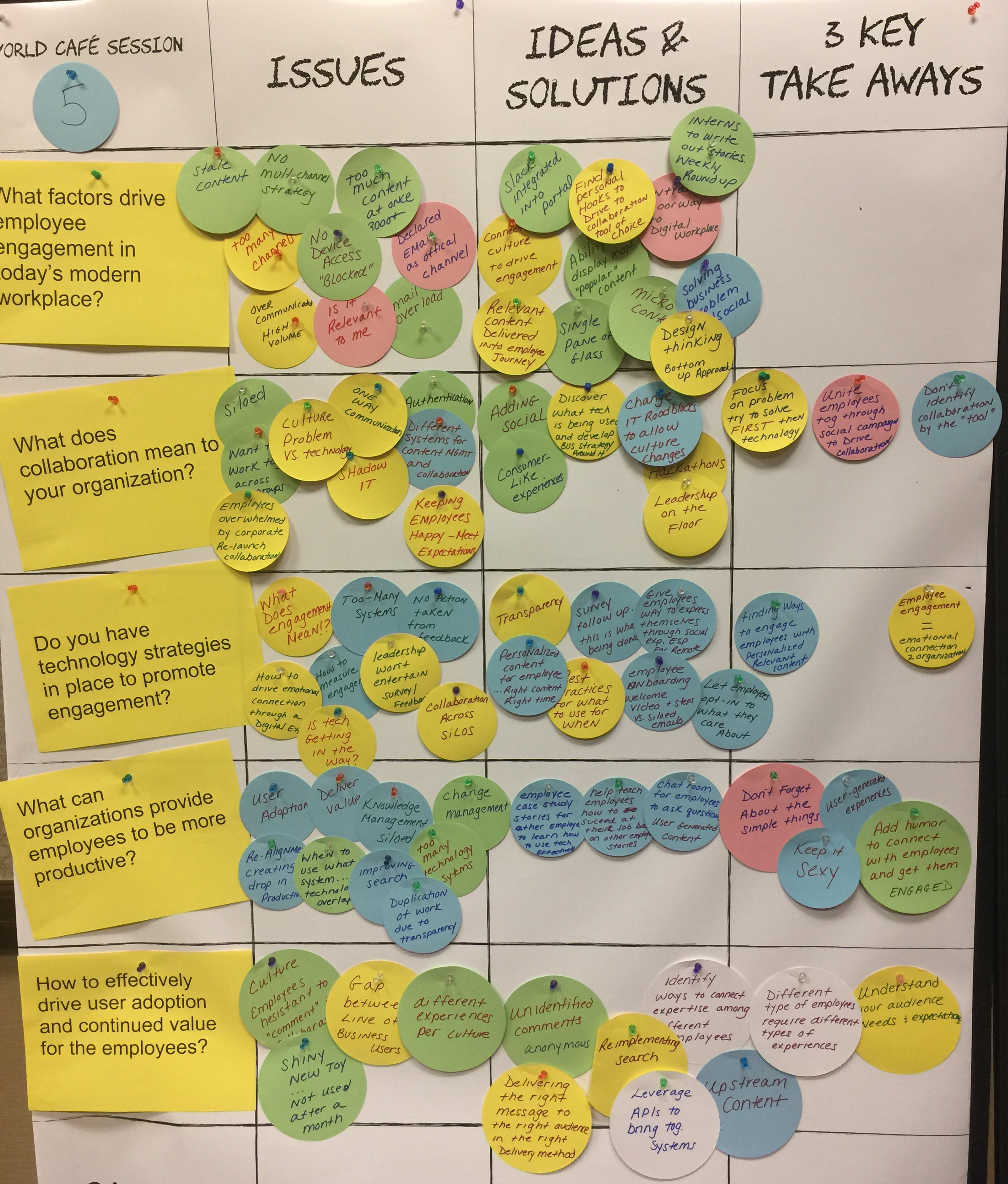
Back at Intra.NET Reloaded in 2021, we brainstormed a lot on how to solve these common issues across different organizations with five groups of business executives. With so many great minds, we did come up with plenty of ideas to improve employee productivity - you can see just how crowded our final board was below! We think these ideas are timeless, but we've added and expanded on this list in 2024 based on even more time spent improving the employee experience for our clients.
1. Foster a Culture of Focus:
- Define Rules of Engagement: There must be clear expectations and best practices on which channels to be used for what, both organization-wide and team or department-wide. Other ideas from our brainstorm included:
- Creating best practice cheat sheets to use channels effectively and know where communication should live, from alerts and company updates to questions, collaboration, and documents.
- Assigning employee advocates to drive change and provide examples of effective channel use.
- Rewarding employees for hitting certain milestones (keeping all document-sharing out of email, for example).
- Gathering ongoing feedback on what's working and not working and making continuous improvements.
- Create Dedicated Focus Time: Implement team, department, or company-wide policies encouraging uninterrupted work periods, such as "no-meeting" days or dedicated focus blocks within calendars. Give employees the ability to create focused spaces and minimize distractions for themselves, whether this is the ability to turn off notifications at points without missing key information, use website blockers or AI-driven automatic calendar and note-taking organizers, or have quiet workspaces available in your building.
- Adjust Work Styles to Overcome Context Switching: If context switching is becoming a significant issue in your organization, you and your co-workers should consider changing your time management method. Task batching, timeboxing, or the Pomodoro method can provide structure for those who need 'deep work.' You can also try booking meetings on certain days of the week or mornings/afternoons only, depending on what works best for your concentration.
2. Optimize Information Flow:
- Create Personalized Content: As with external communication, targeted messages are key to effective internal communication. Tailor your information delivery to the employee's role, goals, location, language, and any other preference to reduce overload. Ensure you understand how your employees consume content and what's appropriate for each region. Different roles, departments, and locations will have different levels of accessibility (device type, language, image/video availability) and expectations.
- Develop a Micro Content Strategy: Break down information into smaller, easily digestible chunks to improve comprehension and retention. Can you say more with less?
- Try Something New: Find creative ways to display relevant content and keep things fresh. Communications shouldn't stay confined within the walls of the intranet: try printing out stories or round-ups and leave copies in your lunch room or provide them to line managers.
- Create Social Campaigns to Engage: Foster a sense of community and shared purpose through internal campaigns and recognition programs. You can recognize employee milestones (anniversaries, life achievements, family changes, etc.) or create social campaigns to allow employees to learn about your leadership team or other team members around the globe.
3. Empower Employees:
- Help Employees Master Their Tools: Sometimes, we take lessons on different technologies and tools for granted, yet expect more productivity with less. People come to your organization with different experiences and familiarity with your tools and processes, so get everyone up to a base level with training and resources across common tasks (e.g. emails, time management, and calendar organizing). Empower employees to share how they stay productive and provide tips and tricks for effectively utilizing your existing technology.
- Respect Employee Preferences: Employees should also feel empowered to establish boundaries and communicate their availability to minimize distractions—this can be as simple as adding working hours or holidays to email signatures. Enable them to set preferences on what kind of content they want to learn about and what they don't, and gather regular feedback to improve your internal comms strategy.
4. Cultivate a Transparent and Supportive Environment:
- Open Communication: Encourage open and honest communication between managers and employees.
- Get Regular Feedback and Action It: During one of our roundtables, we had a long conversation about feedback and transparency. Most agreed that employees didn't feel actions were taken from their feedback or had no visibility into what happened with their feedback. It's important to create transparency that allows employees to understand your company's vision and direction, even if you can't make everyone happy.
5. Make Work Enjoyable:
- Add Humor and Keep It Fun: Sometimes work is boring, but everything has to be done. Find ways to keep things lively and fun, such as adding a bit of humor to your next safety or IT training, creating a video blog for the next corporate announcement, or incorporating contests for conducting the more mundane work.
- Employee Recognition Programs: Recognize and reward employee contributions to foster a positive and motivating work environment.
How Can HR Improve Employee Productivity
As you can tell from some of our tips, HR and Internal Communications departments play a critical role in fostering a productive work environment. We know that communication overload is a significant issue consistently highlighted by employees, with corporate communications contributing much to this. In a survey by FirstUp, employees said they wasted 2.7 hours every week dealing with distractions from poorly executed corporate communications. With an average of 5.3 channels used to reach employees by HR and IC teams in the US, it's easy to see why 12.
But the power is also in your hands to change this. Find out your employees' main productivity struggles and which communications channels they prefer based on data and insights. Equipped with this knowledge, HR teams can design and implement targeted programs to address employee challenges and create internal communications strategies that land.
HR teams are also uniquely positioned to improve employee happiness and productivity through well-being initiatives that address physical and mental health, which is crucial. Healthy and engaged employees are more focused, resilient, and productive long-term.
Intranets can be Productivity Killers or Productivity Boosters
Intranets precariously balance becoming powerful tools for enhancing employee productivity and becoming absolute productivity killers when poorly done.
Cluttered, outdated intranets layer information on information on information, forcing employees to spend more time trawling for the documents and resources they need. Even if they can find them, what they need is often outdated and redundant anyway. Information overload from poor search experiences, constant notifications, and one-size-fits-all homepage designs lower productivity and employee engagement, creating negative work cultures where stress and frustration thrive while employees go their own way through a digital jungle.
However, a well-designed intranet or rejuvenation project can be the antidote to these issues. When created with employees first, intranets can serve as a central hub for all company information, facilitating seamless communication, knowledge sharing, and collaboration. Employees can quickly access necessary information, find answers to questions, and connect with colleagues across departments. Intranet success hinges on user-friendliness, populating with relevant content, and an efficient search functionality.
Ready to transform your intranet from a productivity killer to a powerful booster? Schedule a free demo with our team to learn more about how we can help your organization achieve its full potential.
References
-
https://www.economicstrategygroup.org/publication/in-brief-us-labor-productivity/
-
https://www.gallup.com/workplace/608675/new-workplace-employee-engagement-stagnates.aspx
-
https://www.vouchercloud.com/better-living/office-worker-productivity
-
https://www.cv-library.co.uk/recruitment-insight/brits-falling-victim-always-on-work-culture/
-
https://firstup.io/uk/blog/digital-overload-overwhelming-hr-internal-comms-and-employees/#
-
https://firstup.io/uk/blog/digital-overload-overwhelming-hr-internal-comms-and-employees/#